




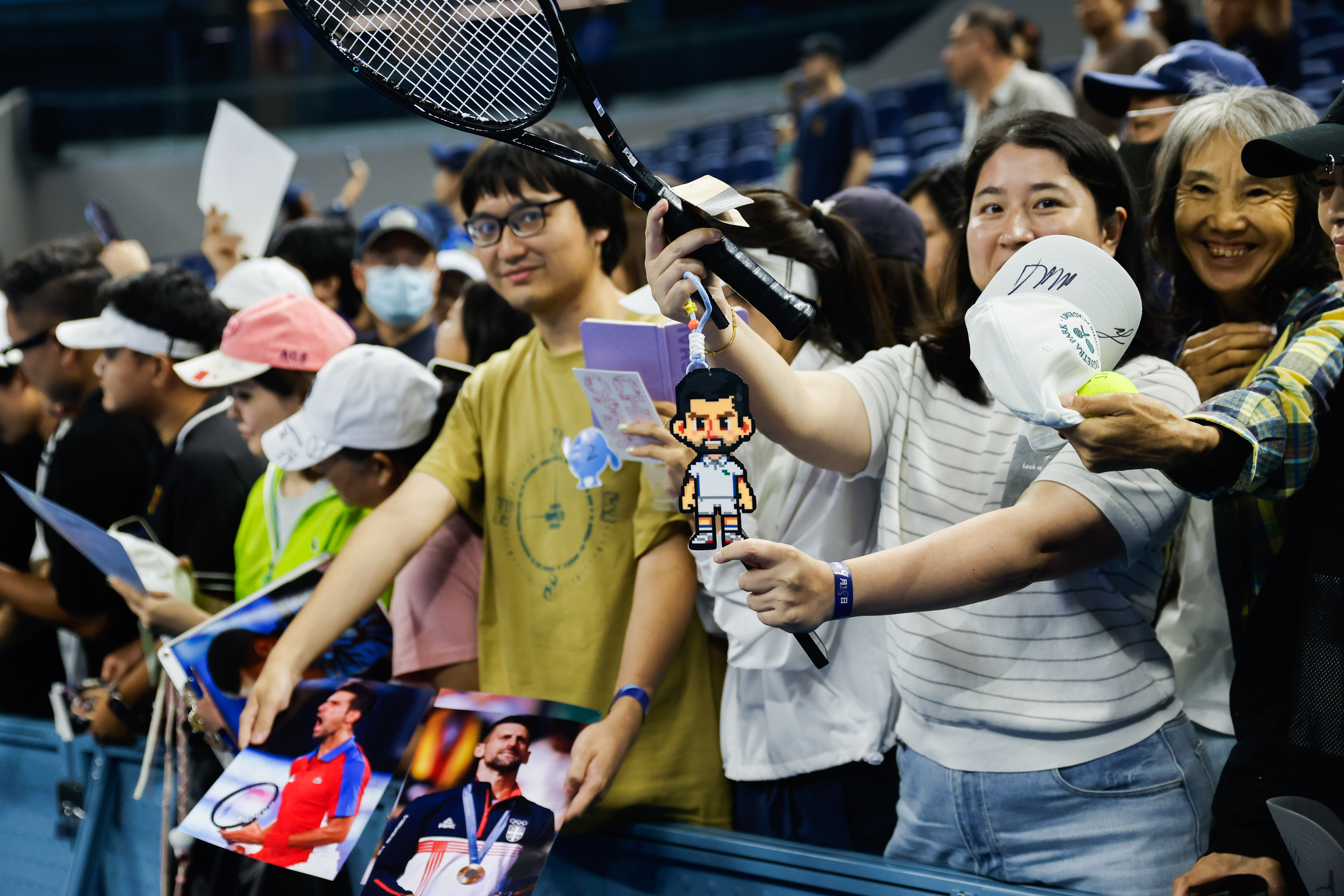
Hundreds of thousands of fans flood the China Open precinct in Beijing to see the best tennis players in the world. Behind each player is a rooting interest shaped by personality, playing style or nationality.
Fans look for ways to show their appreciation for the players who provide them with joy and entertainment. They serenade them with loud cheers, crowd the courtside seats for autographs and arrive with gifts, from oversized stuffed animals to handmade items, hoping for a chance to present them to their favorite players after a match.
But in China, fandom often takes on a personality of its own.

In the early 2000s, as tennis legends Roger Federer and Rafael Nadal were winning championships, Chinese fans began giving their favorite players nicknames. The names often ride on a player’s name, personality or style of play.
The tradition is rooted in the linguistic characteristics of Mandarin Chinese, where similar sounds and homophones create opportunities for wordplay. What began with a handful of international stars has manifested into a distinctive part of Chinese tennis fandom, giving fans their own way to connect with the players they admire.
To Chinese fans, Novak Djokovic is known as “Chicken,” or “Dé Jī,” a play on the first two letters of his family name. Aryna Sabalenka is “Tiger Girl,” a nod to her fighting spirit, the tiger tattoo on her arm and her birth under the Tiger sign of the Chinese zodiac.
Not all nicknames are tied to a player’s personality or style. Fan favorite Coco Gauff became known as the “Fruit Salad Queen” after fans noticed her enjoying assortments of fruit during changeovers, which some believe has become her signature snack.
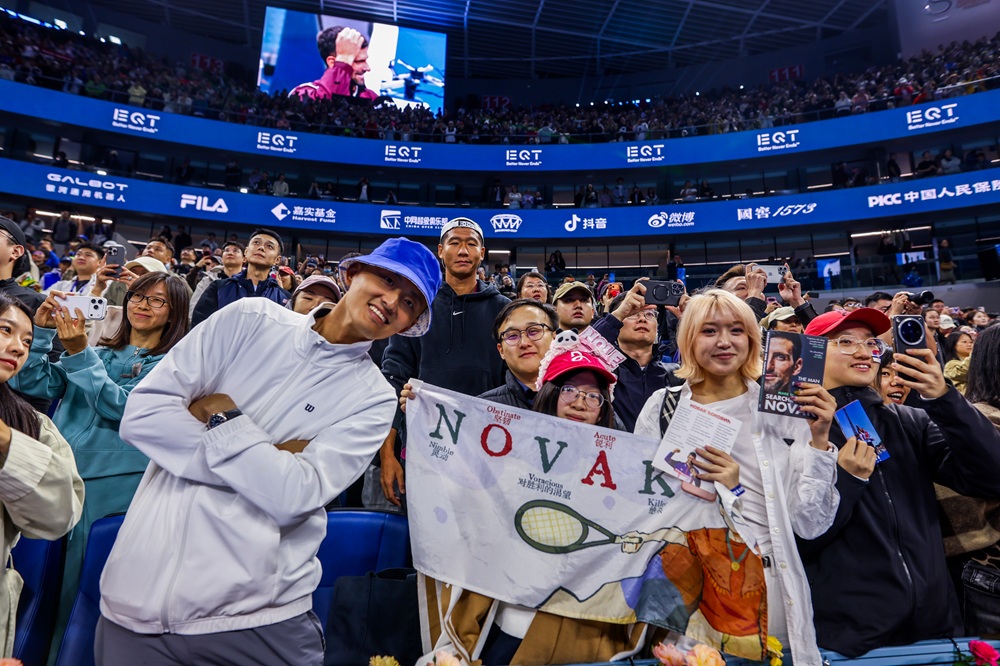
Tennis fans in China are eager to give gifts as a way to show their appreciation to the players.
Beijing native Zhang Mingqi’s fandom started with tennis while watching matches on TV. He came to the tournament with the hopes of watching Djokovic for the first time live.
“If I got the chance to meet him, I would probably pick a gift and give it to him,” Mingqi said. “But more than that, I would want to take a photo with him — and getting his autograph would be the best.”
Young fan Huang Zhixin traveled more than three hours from Shijiazhuang to be able to see her idol, Elena Rybakina. “I would give her a portrait that I drew of her; to show how much I like her. I think that would be pretty special,” Zhixin said, if given the chance.

The personalization behind the gifts is what makes the China Open memorable for the players. To see the thought and love poured into the gifting is what some players could use as motivation throughout the tournament.
Gauff noted that the personal gifts are one of her favorite parts of playing in China. She recalled one of the most memorable fan gifts she has received during the tournament.
“She gave me a Blind Box and also a really nice letter, which kind of made me tear up when I was reading it in my room,” Gauff said. “It was just crazy because I never thought, me from Florida, would impact someone all the way here in China.”

Former World No. 1 Naomi Osaka echoed the sentiment of appreciating heartfelt gifts from fans.
“This year, I received a really nice letter. It made me cry a lot,” Osaka said. “I just love letters from fans because it always feels very personal and I feel like I can feel their emotion.”
Even Djokovic, the undefeated and six-time China Open champion, wants to reciprocate the love he’s always received in Beijing.
“I think sometimes people take that for granted who come here,” Djokovic said. “Of course, as a tennis player, I feel privileged really to be part of this kind of event.”
By Emerson Chaloux, Lainey Hogg, Ye Ruixi, Pranav Sriraman and Rong Xinyue

Weibo@ChinaOpen

WeChat Channel

Douyin@ChinaOpen
