





Listen closely at a China Open press conference, and you may hear another voice — soft and clear, following the player’s words almost instantly and carrying their meaning across languages.
That voice belongs to Lan Jing, a poised and graceful interpreter working from a small room on the second floor of the press center. Behind the glass, she watches the players below, headset on and microphone ready. She interprets between Chinese and English for players from around the world, each with a different accent.
Lan Jing began working at the China Open in 2014, bringing together her longtime interest in tennis and her training in interpretation at the prestigious Monterey Institute of International Studies. Each year, she returns to the tournament for about two weeks.
Over the years, she has also grown closer to the people working around her in the media area. Many familiar faces return each year, and that familiarity has made her feel increasingly part of the China Open.
“When you’ve worked here for so long, you feel more connected to the people around you, and there’s more you can do together,” she said.
More than a decade in the interpreting profession, Lan still finds the work deeply rewarding.
“I really love this work, and I’ve learned so much from it,” she said. “Especially with skills like simultaneous and consecutive interpreting, once you master them, it feels like your brain has opened up. It’s like learning to play the piano. Once you have that skill, you feel, ‘Wow, I’m pretty smart.’”
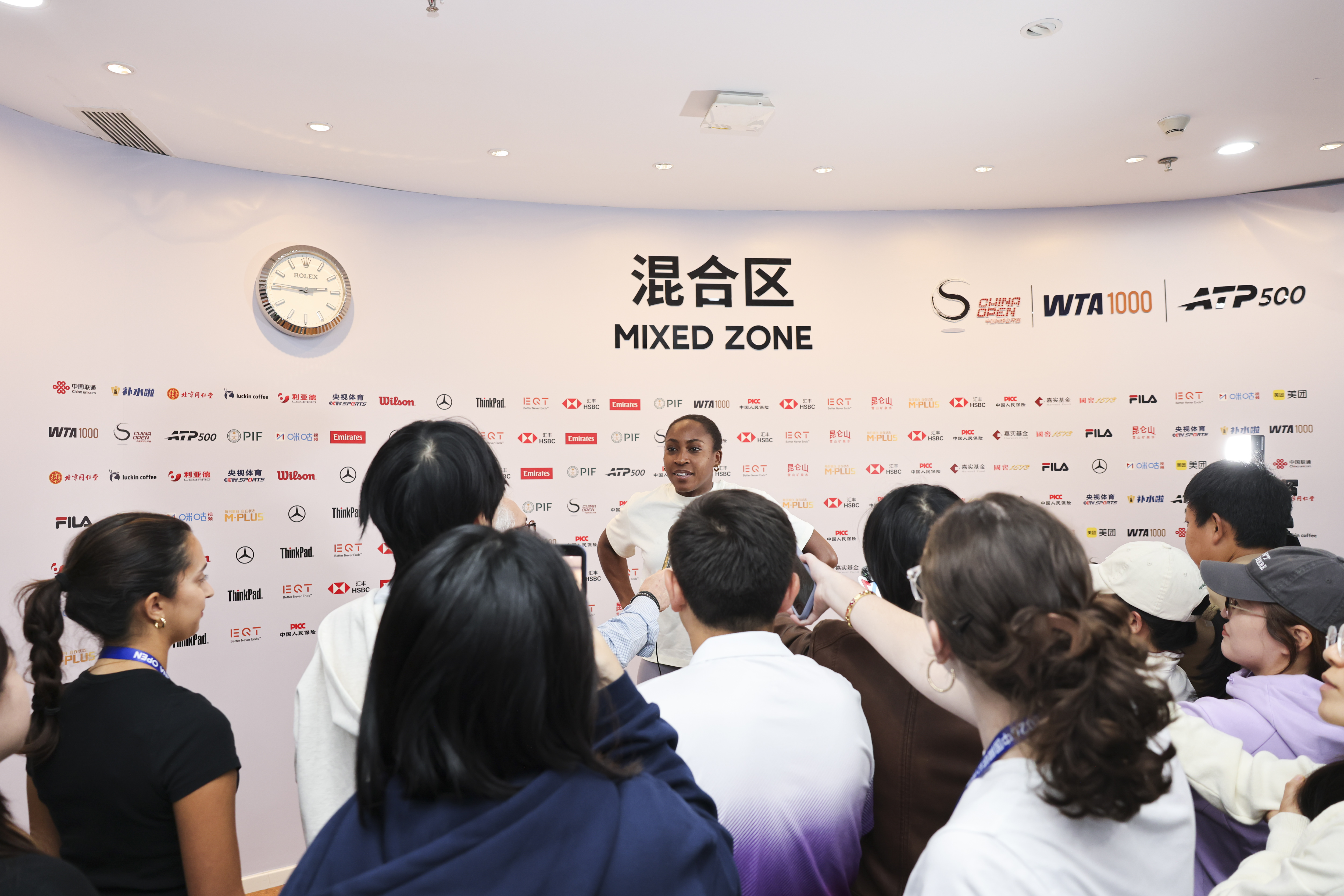
The challenge of simultaneous interpreting is not always about keeping up. In a previous interview, Lan recalled Coco Gauff’s press conferences as particularly demanding because of her speed and wide-ranging answers. Sometimes, however, the difficulty lies in a single word.
That happened during a recent Novak Djokovic press conference. Discussing his physical condition, Djokovic moved between words such as “stamina,” “health” and “fresh” — terms that did not translate neatly into Chinese in context.
“I hesitated when I was interpreting it,” Lan said. “I wasn’t completely satisfied with how I handled it. But maybe it was an unsolvable problem.”
Her work continues after the microphones are turned off.
“We are really the people who read every single word of the transcript,” she said. “The people sitting downstairs may not pay much attention to the players’ choice of words. But afterward, we discuss it ourselves: Why did he use this word? What exactly did he mean?”

Jaime Morrocco, an American transcriptionist who has worked with Lan on English-language transcripts at the China Open for 12 years, has watched that attention to language up close. Lan's care and attention to detail bolsters the China Open's reach, bringing the biggest tennis tournament in Asia to the world.
“For me, she’s the best interpreter that I’ve had in China for all of the tennis events,” Morrocco said. “I love Lacy. She’s one of my best friends. We’ve become very, very close”
Morrocco said Lan’s experience has made her increasingly familiar with players’ names and the language they use, while her willingness to keep learning has remained unchanged.
“She’s always wanting to learn, always, always, always,” Morrocco said. “And the best thing about Lacy is her pronunciation is very, very good.”
By Zhao Yiwei and Liang Yanxi

Weibo@ChinaOpen

WeChat Channel

Douyin@ChinaOpen
