




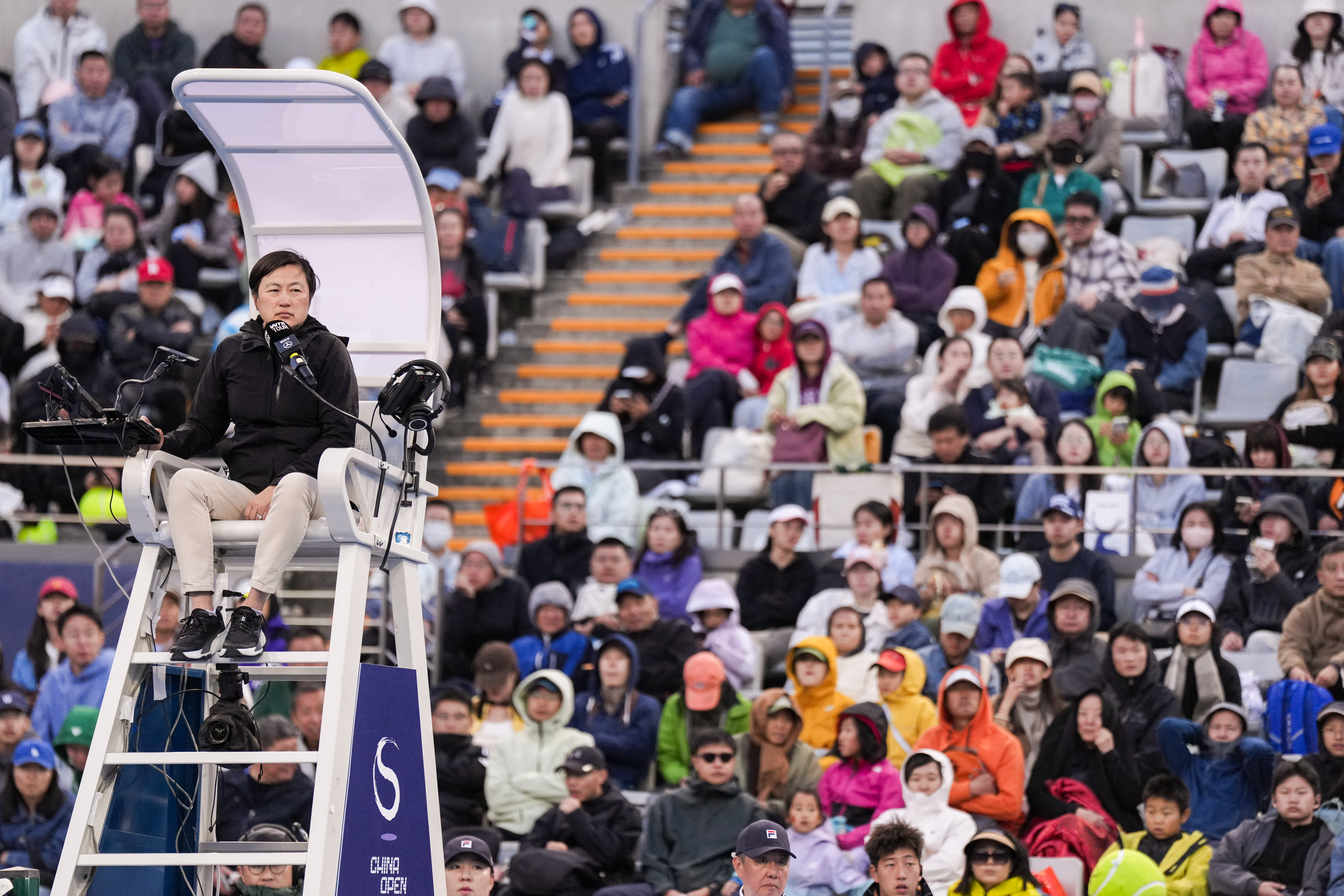
At the China Open, an umpire’s journey to the chair beside the net begins far away from the tournament’s grandest courts.
Those hoping to officiate at the sport’s highest level must go through extensive training. The path typically begins at entry-level tournaments, where aspiring officials work as line judges before advancing through a series of evaluations and written examinations that test their knowledge of the rules and the nuances of officiating.
For chair umpires, the educational process is simply called “school.” Renaud Liechtenstein, a French gold badge official, said the training tests officials on both their knowledge of the rules and their ability to handle the countless situations that can arise during a match.
“We call them schools because you go like for three or four days,” Liechtenstein said. “You go in the school, and you have some tests. You do some tests in the chair and then also take theoretical tests.”
Officiating assignments at tournaments are dictated by the badge level of the official. The badges start at white and progress to bronze, silver and gold. Through a series of examinations at the schools and assessments of on-court officiating performances done by the governing bodies, ATP and WTA, officials can improve their badge status.

Zhang Juan (Jennifer), the first Chinese woman in history to hold a gold-level badge, said she was constantly being evaluated for over a decade.
“You get evaluations based on your performance each year,” Zhang said. “How many tournaments you're doing, how many matches you're doing, different levels. That's how they make an assessment. I was always getting evaluated.”
With technology becoming an ever-increasing component of officiating a tennis match, Liechtenstein, who has officiated matches such as the 2022 Wimbledon Final between Novak Djokovic and Nick Krygios, said that calmness is the most important trait for an official.
“You need to be calm,” Liechtenstein said. “Even if something is happening, and even if you made the wrong decision and the players are yelling at you, I think you need to be able to not show things to the audience.”
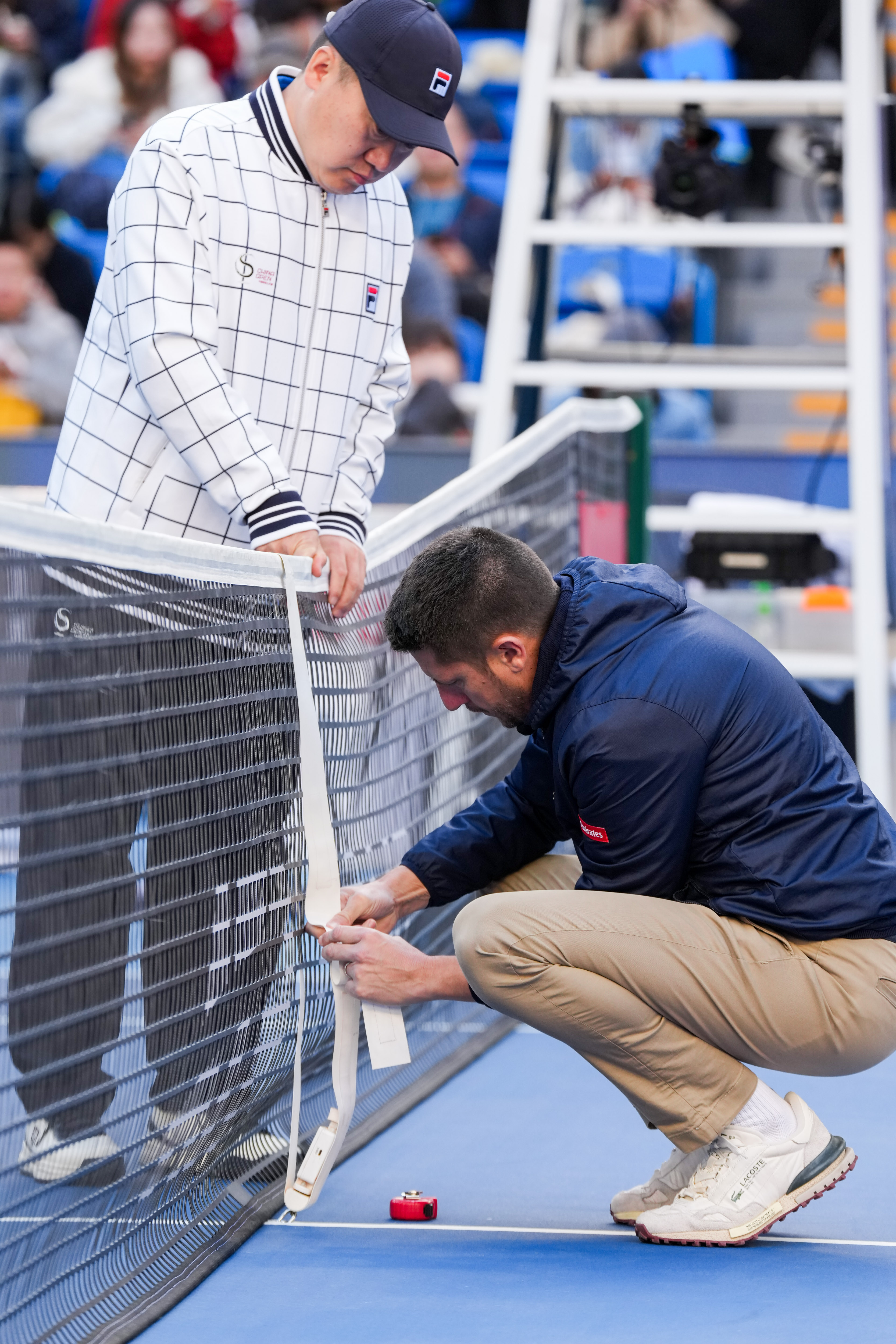
For a job that has the level of travel demand the position of chair umpire does, motivation to return to the seat is something that officials need to find internally.
Zhang said that the pressure that comes with her job comes from the motivation to be better.
“The motivation I think is the pressure,” Zhang said. “It’s like stress. You have to handle it, but you also push yourself every day. It’s a new match to do better job for that.”
The China Open presents a unique set of circumstances that officials need to account for in their preparation.
For Liechtenstein, officiating in China presents an added challenge — communicating in an environment where he does not speak the primary language fluently.
“China Open is different because we have the language that is a barrier,” Liechtenstein said. “So, I'm trying to catch a few words to be able to control the crowd, to control the ballkids. I try to make sure that I’m able to perform at my best level when I come to China.”

Beijing, the host city of the China Open, has a rich tennis culture, resulting in a strong pipeline of China Open officials from the city.
Zhang, a Beijing native, got into the business of chair officiating when the city won the race to host the 2008 Olympics back in 2001. Her dad advised her to get involved with the sport professionally while not actually playing.
“The reason why I do officiating is because my dad said I was not good enough as a player,” Zhang said. “So maybe do this, something will be very exciting.”
Roland Herfel, supervisor of the ATP, said that the group of officials at the China Open are among the best the world has to offer.
“There is a pool of officials,” Herfel said. “It’s a very elite group that we send to tournaments around the world … and they’re on show here at the China Open.”
By Pranav Sriraman

Weibo@ChinaOpen

WeChat Channel

Douyin@ChinaOpen
