





Singles tennis is a battle fought alone, but doubles is about making one plus one greater than two.
Chinese doubles players Xu Yifan and Tang Qianhui formed a quick connection despite a twelve-year age gap, an eighteen-centimeter height difference, and a first season playing together. Xu, the 1.65-meter left-hander, darts around the net with quick agility; Tang, the 1.83-meter power player, dominates high balls and blocks shots from above. Pairing up for the first time this season, they advanced to the doubles semi-finals at WTA 500 events in Monterrey and Washington, and fought all the way to the doubles final at the WTA 500 tournament in Singapore.
Xu and Tang explained the secret behind their teamwork at the China Open.
“She’s the slam dunker, and I’m the pixie,” Xu said with a smile, describing their on-court roles. “I cover the net and dart left and right, while she handles the high balls.” The taller Tang hunts down lobs and smashes anything within reach; Xu, meanwhile, moves like she has a motor, cutting off passing lanes.
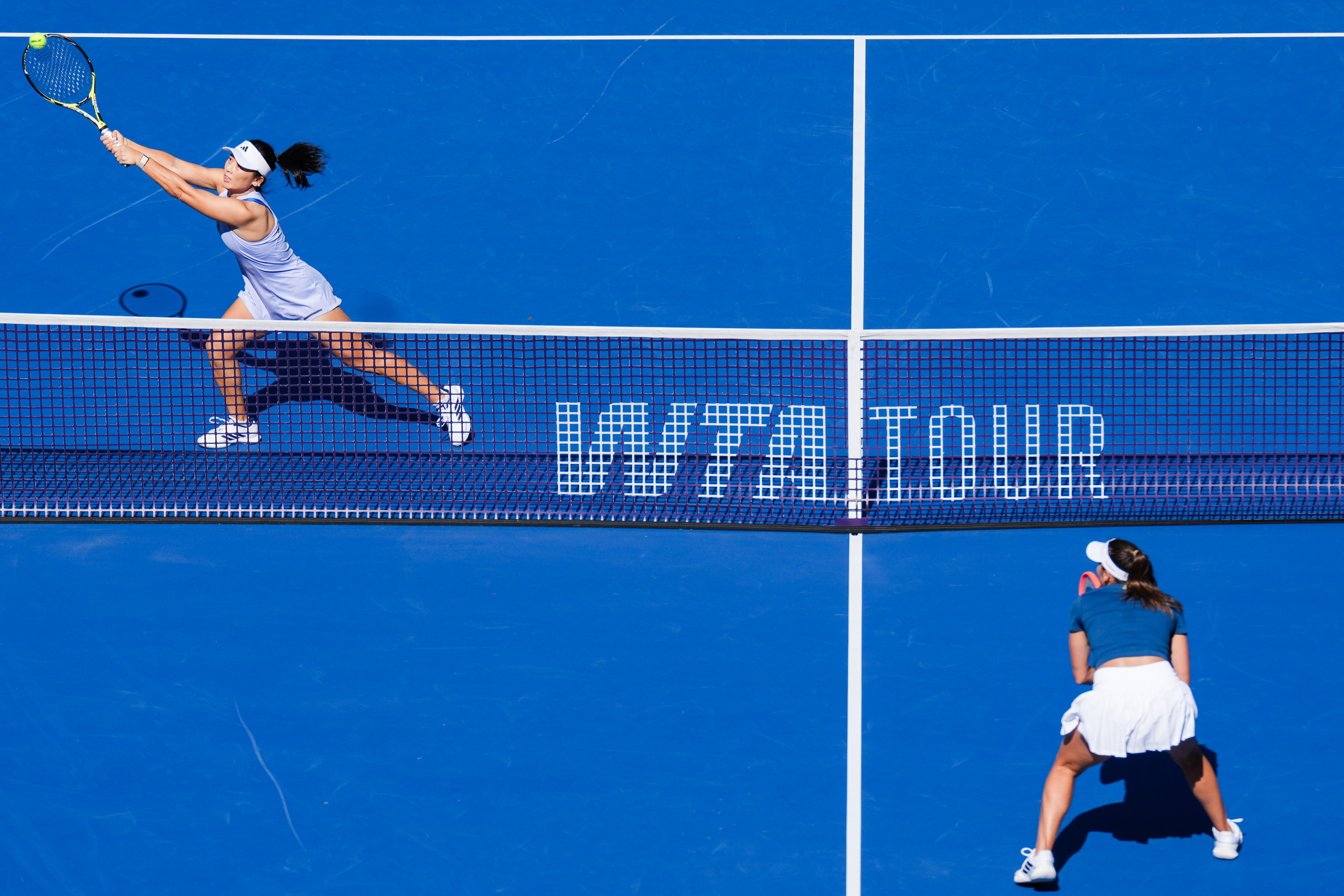
The age gap bridges what physical conditions alone cannot. The 38-year-old Xu brings sharp court instincts and composure on key points, forged through three Grand Slam final appearances; the 26-year-old Tang contributes baseline power and court coverage. Their dynamic showed even at the media conference: Xu almost always answered first, steady and measured, while Tang would lean in with a quick supplement — or a joke that sent both of them laughing.
However, this duo is not a long-standing team. Pairing up for the first time this season, they had to achieve in a few months the chemistry that usually takes years to build. When asked how they developed their communication, both gave relaxing answers: “Play more matches, talk more, and share more meals.”
“Whether on or off the court, chemistry builds naturally over time. Sometimes a single glance is enough to know what the other is thinking,” Tang said. “You don't need to force anything. It just comes from spending time together.”
No elaborate routines, no complex adjustment process — just shared battles, post-match debriefs, and everyday camaraderie. That mutual trust showed again when trailing on court. “We focus on tactical adjustments rather than overthinking,” they shared. “As long as our strategy is clear, missing a shot doesn't bother us too much.”

At the China Open, that trust was tested early. They faced a tough first-round matchup against high-seeded opponents Gabriela Dabrowski and Luisa Stefani, whose big serves ultimately halted their run, winning 6-4, 6-4. They ran into an experience gap that scoreboards don't measure. Yet their debut season has already proven successful, and built a sturdy foundation to build on.
Reflecting on the match, they faced their issues openly. They noted that their opponents had a high first-serve percentage with deep placement, putting heavy pressure on their returns. Combined with windy conditions, a few key points slipped away.
“Doubles often comes down to key points,” Xu noted. “Losing just one service game can cost you the entire set.”
Still, they remain clear-eyed about their strengths: “Our break-point opportunities were actually better than theirs. Our net interceptions, as well as our ability to encourage and support each other, are areas where we excelled.”
In Beijing’s autumn breeze, their story continues.
Next time they high-five at the net, may they hear not only the applause, but also the sound of victory.
By Ye Ruixi, Rong Xinyue

Weibo@ChinaOpen

WeChat Channel

Douyin@ChinaOpen
