




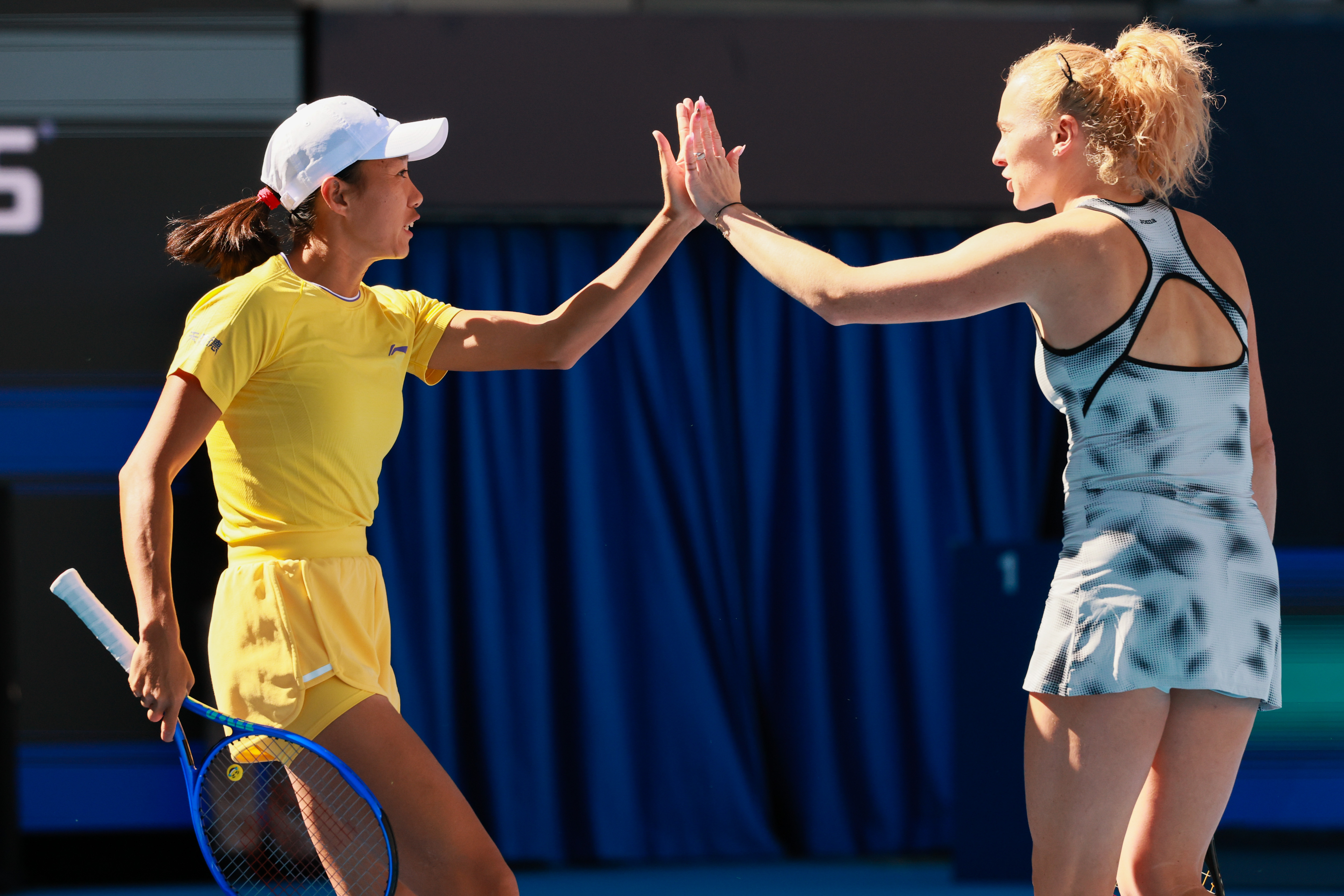
After defeating Yuan Yue and Feng Shuo 6-1, 7-6(4) in the first round of the China Open's women's doubles, Zhang Shuai walked into the press conference room. After the first question, she smiled and said, “First, I’d like to say the same thing: Welcome back to Beijing.”
It had been just four days since she returned to Beijing from the Asian Games in Nagoya, Japan, and her women’s doubles campaign at the China Open was already underway. But there was a spring in her step as she she returned home. In Japan, she was part of a all-Chinese gold medal match in singles, where she took silver to her good friend Wang Xiyu.
People affectionately call Zhang, "Shuai Jie" (Big Sister Shuai). Since turning professional in 2006, she has walked the tennis path for twenty years, witnessing and accompanying the growth of a new generation of Chinese women’s tennis players along the way.
There were only two days between her return from Nagoya and her opening match. “I trained for four hours on the first day and three hours yesterday. After arriving at the China Open, I had only one hour of court practice yesterday afternoon before stepping onto the court today,” she said. “Before the match, I wasn’t entirely sure if I could play the way I wanted, but that was the reality, and I just tried to do my best.”
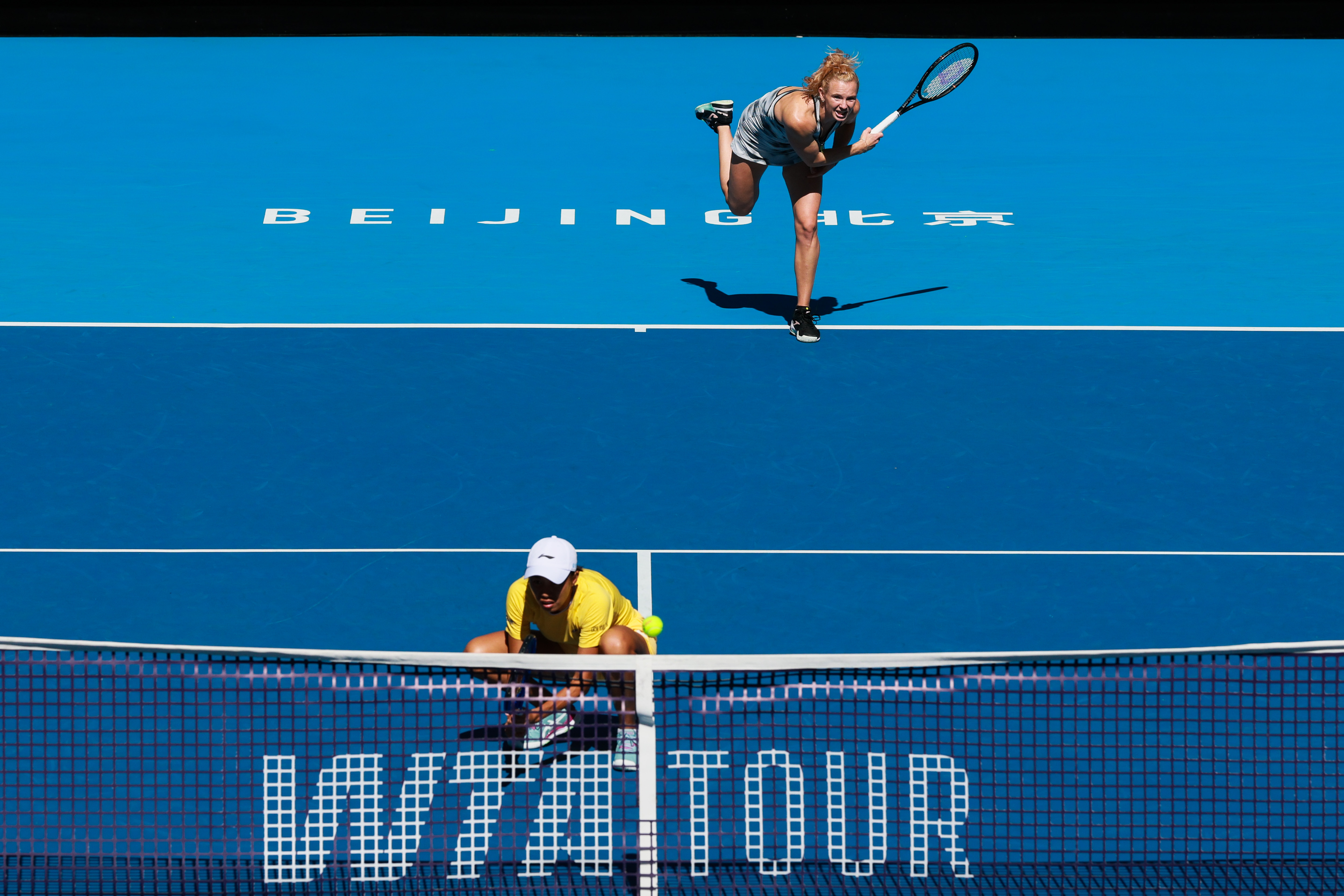
In her life, everything takes a backseat to tennis.
“In my life, everything else has to make way for tennis. Eating, resting, and sleeping are all for playing well and training hard. That’s what makes a professional tennis player,” she noted.
Her daily routine follows a strict pattern: upon waking up, she first thinks about what to practice. Only after finishing her training and feeling satisfied internally does she feel truly happy. “Then I’ll smile no matter what I do or who I meet,” she said. If a session goes poorly, she gets fully absorbed in fixing it: “I have to find time to rework it.”
In the Asian Games singles semifinals, she faced Yulia Putintseva of Kazakhstan, an opponent she had struggled against in recent years. In 10 career meetings, Zhang won just three. “Looking back at our head-to-head record, it was often 1-6, 2-6. Honestly, sometimes I wondered from the bottom of my heart how I could win.”
However, she won 6-4, 6-2, returning to the Asian Games final after eight years.
“When I received the task, I was already 37 years old and competing in both singles and doubles. But I accepted it without hesitation, determined to give everything to secure the gold medal,”she said. “Gold and silver medals at the Asian Games are incomparable to other tour events because we are playing for Chinese women’s tennis and the Chinese sports delegation.”
She recalled the challenge she played for China. The last time at the Fed Cup in Kazakhstan, she fought for over three hours. “You see, every time in moments like that, the strongest version of Zhang Shuai is brought out.”

When she was young, her coach often told her that human potential is infinite. “I thought 17-year-old me could unlock a lot of potential, but I didn’t expect that at 37, I would still be pushing my maximum limits,” she reflected.
This venue has known her for 17 years.
The China Open first got to know Zhang Shuai in 2009. Back then, the 20-year-old pulled off a major upset by defeating world No. 1 Dinara Safina, securing her first main-draw victory on the WTA Tour.
Fans have known her story well since then. She endured a dark period of 14 consecutive first-round losses in Grand Slam singles main draws before breaking through at the 2016 Australian Open. Last year, she endured a 23-match losing streak in singles before finally getting a win here at the China Open.
Since shifting her primary focus to doubles, Zhang Shuai has enjoyed the greatest success of her career. She has won Grand Slam titles at the 2021 US Open and 2022 Wimbledon, adding a third at this year’s Australian Open.
Partnering with World No. 1 Kateřina Siniaková this season, she won three titles, including the WTA 1000 event in Toronto and the Adelaide tournament, raising her doubles world ranking to No. 7.
It is precisely her experience of rising from low points that has made her the most trusted big sister for younger players.
Over the six years she has known Wang Xiyu, a rising star in Chinese women's tennis, Zhang Shuai has constantly offered encouragement: “I always tell her: you must stay positive, you must believe in yourself, and believe in how good you are.” Wang Xiyu responded warmly after a match: “When I lacked confidence the most, she was always the one telling me I could do it.”
That same warmth extends to her opponents on the court. Even after defeating Yuan Yue and Feng Shuo in Beijing, she was generous with her praise, noting how the young pair made impressive adjustments in the second set: “I think that shows the quality of truly great players. I hope they keep working hard and one day realize their dreams.”

For Zhang Shuai, supporting young players is not just personal kindness. It is about the future of Chinese tennis.
At her China Open media conference, a reporter asked her to evaluate the state of Chinese women’s doubles. Her answer began with the 2004 Athens Olympics: “Chinese tennis started with women’s doubles. Our first Olympic gold medal came from women’s doubles, and our first Grand Slam title was also in doubles. Women’s doubles has always been our strong suit.”
“Seeing so many talented Chinese players performing well in doubles, I am first and foremost happy for them. Only with the rise of young players can Chinese tennis have a future. Otherwise, we would fail to live up to the foundation laid by the senior players before us.”
She herself is someone who took over that foundation and passed it on. At age 30, she felt she should focus on doubles to carry forward the legacy built by older players: “So I followed in their footsteps and became a Grand Slam champion.” Seeing young players win Grand Slam titles and make breakthroughs over recent years, she said, “I hope they keep playing better and better.”
She summed up her journey in one sentence: “I have indeed poured everything into tennis, but my tennis career has also given me everything I ever dreamed of.”
With the national flag from the Asian Games still close to her heart, the matches in Beijing have already begun. For Zhang Shuai, fighting for her country and enjoying tennis have never been two separate things. At 37, a person who continues to unlock her maximum potential is fighting for far more than just her own name.
By Ye Ruixi, Rong Xinyue

Weibo@ChinaOpen

WeChat Channel

Douyin@ChinaOpen
