




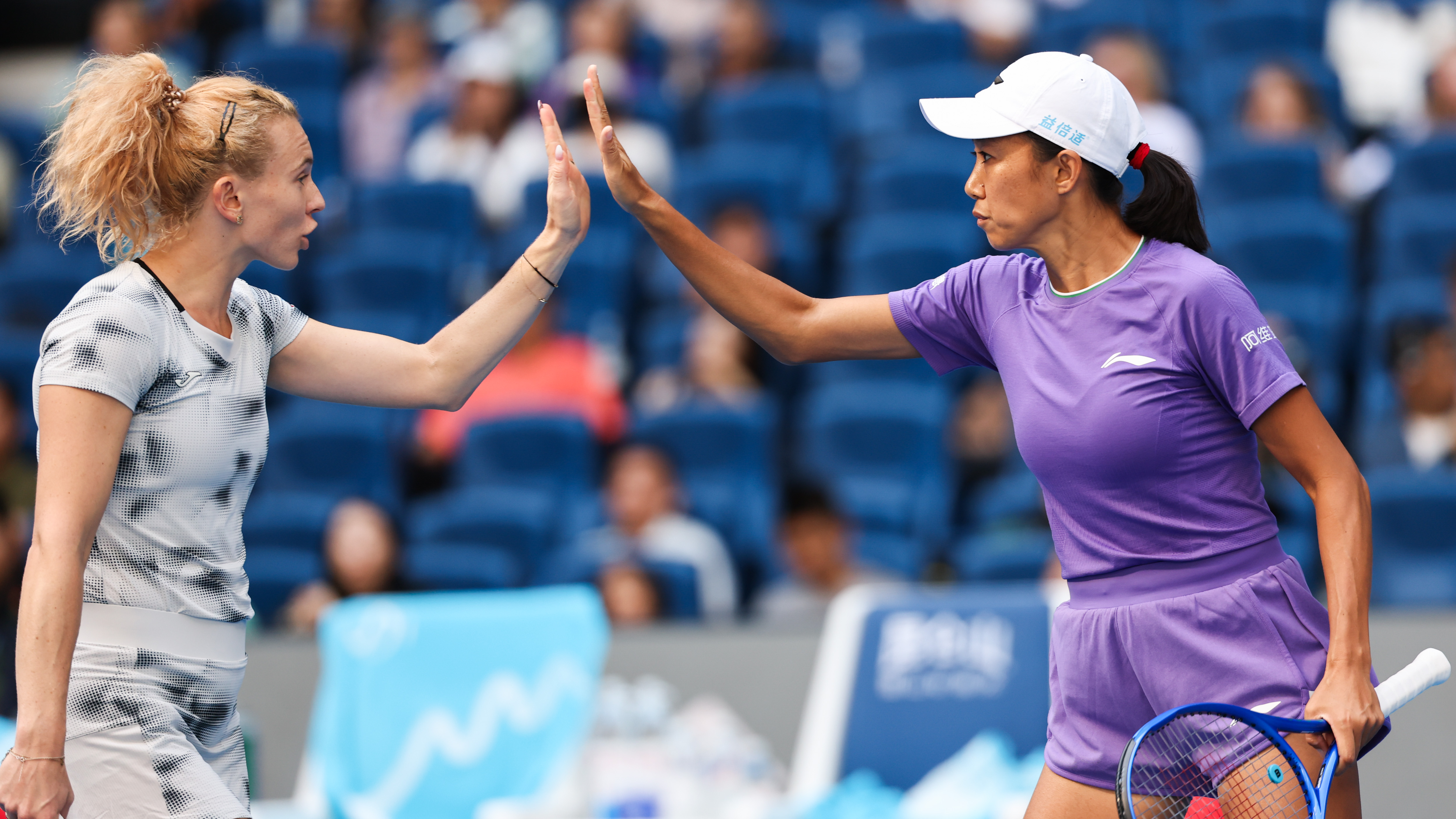
On Sunday, the China Open’s women’s doubles title will be up for grabs, with top seeds Katerina Siniakova and Zhang Shuai set to face No. 2 seeds Gabriela Dabrowski and Luisa Stefani.
Zhang and Siniakova have been on a tear this season, winning titles in Adelaide and Toronto and reaching the final in Beijing without dropping a set. Their success is reflected in the rankings. Siniakova sits atop the WTA doubles rankings, with Zhang not far behind at No. 5 looking to push further up the ladder before year’s end.
But rankings and titles tell only part of the story of doubles. Sustaining that kind of success takes more than technical skill. It takes trust, communication and a partnership that holds up under pressure.
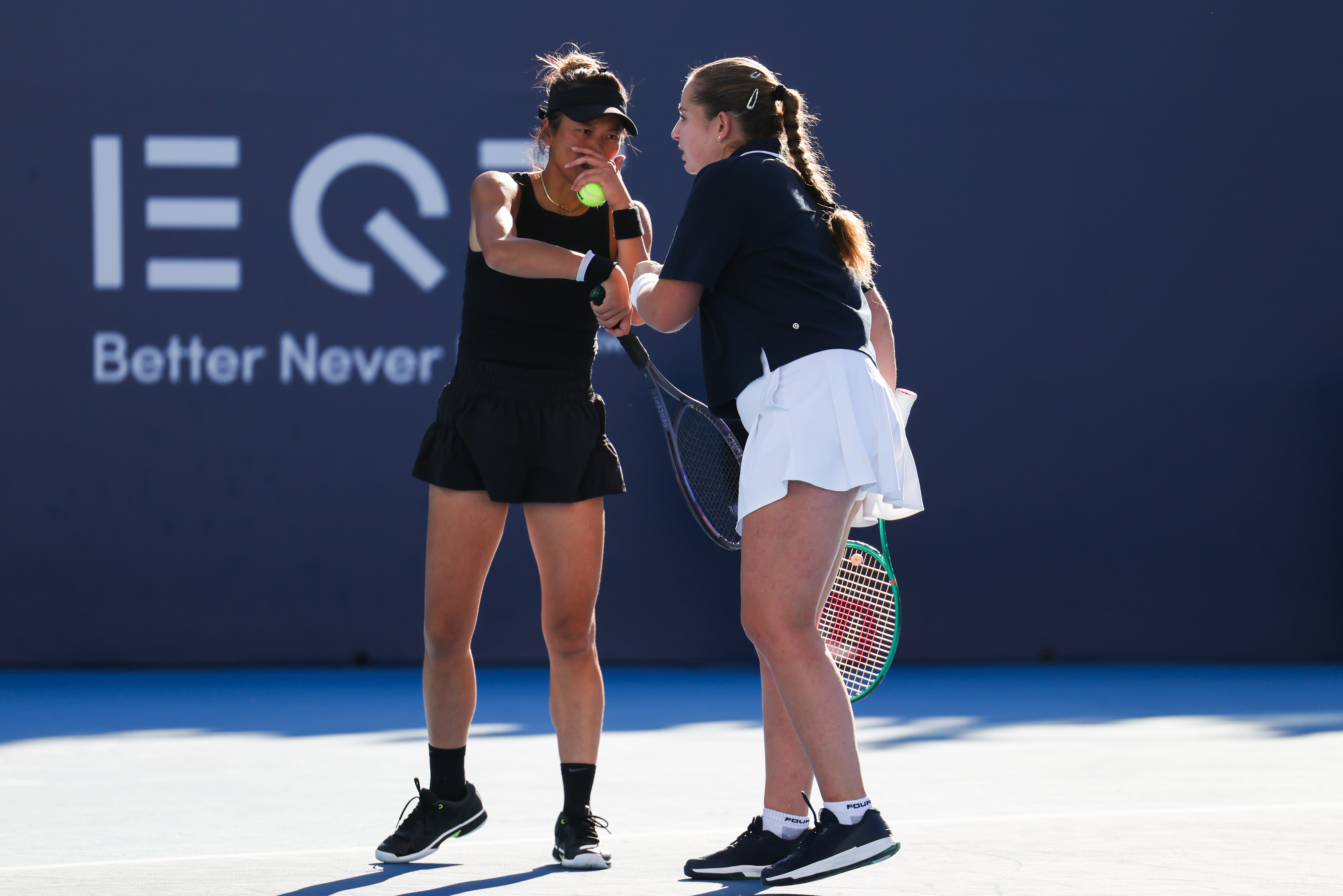
It’s the first round of the women’s doubles tournament at the China Open. Jelena Ostapenko and Hsieh Su-wei face Chinese pair Wang Xiyu and Jiang Xinyu.
Ostapenko rips a serve into the corner. Wang scrambles to return it. Ostapenko fires a backhand. Wang stretches, somehow sending it back. Hsieh lunges for a volley. Wang chases it down and floats it over the net. Hsieh attacks again, drilling the ball straight at Jiang. No time to react. The ball ricochets off her racket and drops at her feet. The fluorescent yellow blur bounces twice, then finally stops.
Point, Ostapenko and Hsieh. Ostapenko roars. Hsieh turns to her partner for a high-five.
Seven shots. Eight seconds. One point.
And then, just like that, it’s over. The players reset. The next point begins.
Across the China Open, thousands of exchanges like this unfolded in a relentless blur of power, reflexes and split-second decisions. What looks extraordinary to the uninitiated is routine for the world’s best doubles players. A point can demand every ounce of athletic ability and tactical awareness a player possesses, only to disappear into the scoreline seconds later.
Ostapenko and Hsieh, two of the biggest names in the field, would go on to win the match. But this eight-second exchange was just one small moment in a much larger tournament, one flash of brilliance among thousands.
That’s the beauty of doubles tennis — twice as much of everything that makes this element of the sport so entertaining. The game is chaotic, reactive, organic and violent, without sacrificing strategic depth. One second, it looks like the most beautifully choreographed dance, and the next, a brutal knockout fight. The unpredictability of each point is part of the charm. And through it all, partners must remain perfectly in sync, anticipating each other’s movements and reacting in a split second.
That chemistry can turn a team of talented individuals into a championship-winning duo.
“It’s a little bit like a relationship,” said Ostapenko, the 2024 U.S. Open doubles champion. “Your personalities have to match, and you have to help each other in the right moments.”
Ostapenko and Hsieh have been partners for nearly two years, but their on-court chemistry suggests a decade of playing side by side. Though their China Open run ended in the quarterfinals, the duo showcased the creativity that makes doubles so captivating. The 39-year-old Hsieh, one of the most accomplished current players on tour, brings an unorthodox style built on two-handed groundstrokes and offbeat slices struck at geometry-defying angles.
“If I play some stupid stuff she needs to control me,” Hsieh joked, miming a video game controller with her hands. “If she needs to control me, she controls me. If I play good, I control myself. So, we are trying to match any situation.”

While the women’s side is heading into the final, the men’s doubles side has concluded, with Lloyd Glasspool and Julian Cash winning the title. The two Brits beat singles World No. 2 Alexander Zverev and Marcelo Melo along the way; Zverev was playing his first regular tour event since winning the US Open singles crown.
“A team beats two good individuals, and you see that a lot when it’s singles versus doubles,” Glasspool said. “It’s a massively important component of the game. Chemistry is massively important. You have to know you’ve got each other’s back.”
Neither Glasspool nor Cash have ever been ranked inside the top 200 in singles play, but the pair achieved doubles rank No. 1 and No. 2, respectively in August of 2025, clearly showing how singles skill doesn’t translate one-to-one. They credit their success to a British tennis culture that emphasizes teaching doubles to young players. Now, they serve as an inspiration to younger generations that singles is not the end-all-be-all.
“Making (doubles) a priority, making kids understand that it is a path they can go down if their game suits that style of play especially, they can kind of nurture those skills from a young age,” Cash said.
Today, singles dominates the public imagination of tennis, while doubles often gets lost in the shadow of the sport’s biggest stages. But exciting duos like these Englishmen and the cross-cultural pair of Ostapenko and Hsieh are proving with their poise on court why people should — and do still — care about doubles.
At its best, doubles offers something singles never can: the chance for the sport’s brightest talents to share not just a point, a match or a title, but a story worth telling together.
By Jackson West

Weibo@ChinaOpen

WeChat Channel

Douyin@ChinaOpen
