





Zheng Qinwen could have easily been lost in the thunderous Capital Group Diamond Court celebration of her historic China Open championship on Sunday night.
She became the first player from China to win the singles tournament and won her first WTA 1000 tournament. She sang karaoke to a packed crowd of 14,000 adoring fans. And she was enshrined in Beijing forever at the China Open's traditional handprint ceremony.
The 24-year-old Zheng also added another incredible chapter of her comeback story. Zheng won the 2024 Olympic gold medal, became a Chinese sports icon and reached the dizzying heights of No. 4 in the world rankings. But she also had an injury-fueled fall outside the Top 150. With her resurgent quarterfinal run to the U.S. Open quarterfinals and her China Open championship, she is now back in the Top 25.
It's been a wild ride, to say the least. But Zheng isn’t ready to for it end. She's already focused on what’s to come.
“I’m so hungry, honestly, for what’s going to come next in my career, because I know my potential, and I don’t want to regret the day I retire from tennis,” Zheng said. “I just want to give everything I have.”
Through hard work, discipline, and humility, Zheng has recaptured the magic that got her Olympic gold in Paris two years ago and gave her an almost “too good to be true” story in the last two months.
Zheng’s road back to the top has been far from easy.
After bringing home China's first Olympic singles gold medal, she began to feel discomfort in her elbow. She played through the pain in 2025 before ultimately opting to have surgery in July of that year. Apart from a gritty appearance at the China Open, which ended in a third-set retirement to this year's Wimbledon champion Linda Noskova, the surgery sidelined Zheng for six months. She returned in February this year, but she struggled to knock off the rust.
In the span of 12 months, Zheng went from a career-high No. 4 to a stunningly low No. 160. The cacophonous roars of support had turned into something very different. The whiplash was hard to take.
“When I was at the lowest moment, everyone was saying I couldn’t come back,” she said. “Everyone has doubts about me. I felt like I just forgot how to compete after coming back from the injury.”
Zheng admitted that when she realized she was in a slump, not even she thought it could last as long as it did. She lost in the first rounds of RolandGarros in May, and broke down in tears at her post-match press conference. Then came another first-round exit at Wimbledon.
After first-round losses in Washington and Toronto in the beginning of August, the reality finally set in. Zheng was going to have to play US Open qualifying, battling it out with players ranked outside the Top 100 for a privilege that had once been automatic: a main draw spot at a Grand Slam.
“Everybody faces a slump,” she said. “I’m living under the magnifying glass. I’m living in front of the camera.
“I was forced to learn a lot,” she continued. “I rediscovered myself. I knew that when I wasn’t playing well, a lot of voices emerged. I learned to coexist with myself, to not be disrupted by those voices.”
What followed would become integral to the lore surrounding Zheng's phoenix-like resurgence. She decided to skip the WTA 1000 in Cincinnati, opting to head to the IMG Academy in Florida for one of the most brutal training blocks of her career.
When returned for the U.S. Open, it was clear something was different.
Zheng made it through qualifying, and cruised in the early rounds. Then came the dramatics. She saved a match point to mount a stunning comeback from 5-0 down in the third set against Madison Keys and then defeated Iga Swiatek in straight sets to make her first Grand Slam quarterfinal since her surgery.
At the China Open, Zheng was met with packed crowds cheering her name at every match, and the energy fueled her.
With each match, it seemed as though Zheng was gaining more and more momentum with each passing shot.
Zheng dropped a set in each of her first four matches of the tournament. But it was in the quarterfinals that she reached another level. She knocked out No. 7 Elina Svitolina, followed by No. 19 Elise Mertens in the semifinal, both in the straight sets.
There was an air of inevitability around Zheng as she headed to the final. But she was tasked with her toughest opponent of the tournament, a red-hot Mirra Andreeva, who had won her previous 10 sets and was about to become the WTA's new World No. 3.
In the first set, Zheng saved three set points and won 10 consecutive points to close the set. She sealed the set with the ace. After breaking Andreeva late in the second set, Zheng sealed the match with another ace.
Zheng was the definition of "battle tested" in Beijing. She dropped 78 games en route to the championship, the most by a player winning a Tier 1/WTA 1000 even since the format was introduced in 1990. Only Keys, who dropped 87 games at the 2025 Australian Open, has dropped more games en route to winning a tour-level title in the Open Era.
This tournament was a microcosm of the last two years, in many ways.
“When I was battling my opponents,” she said, “I was also battling myself.”
And she beat both, suggesting her future is brighter than the brightest of her past.
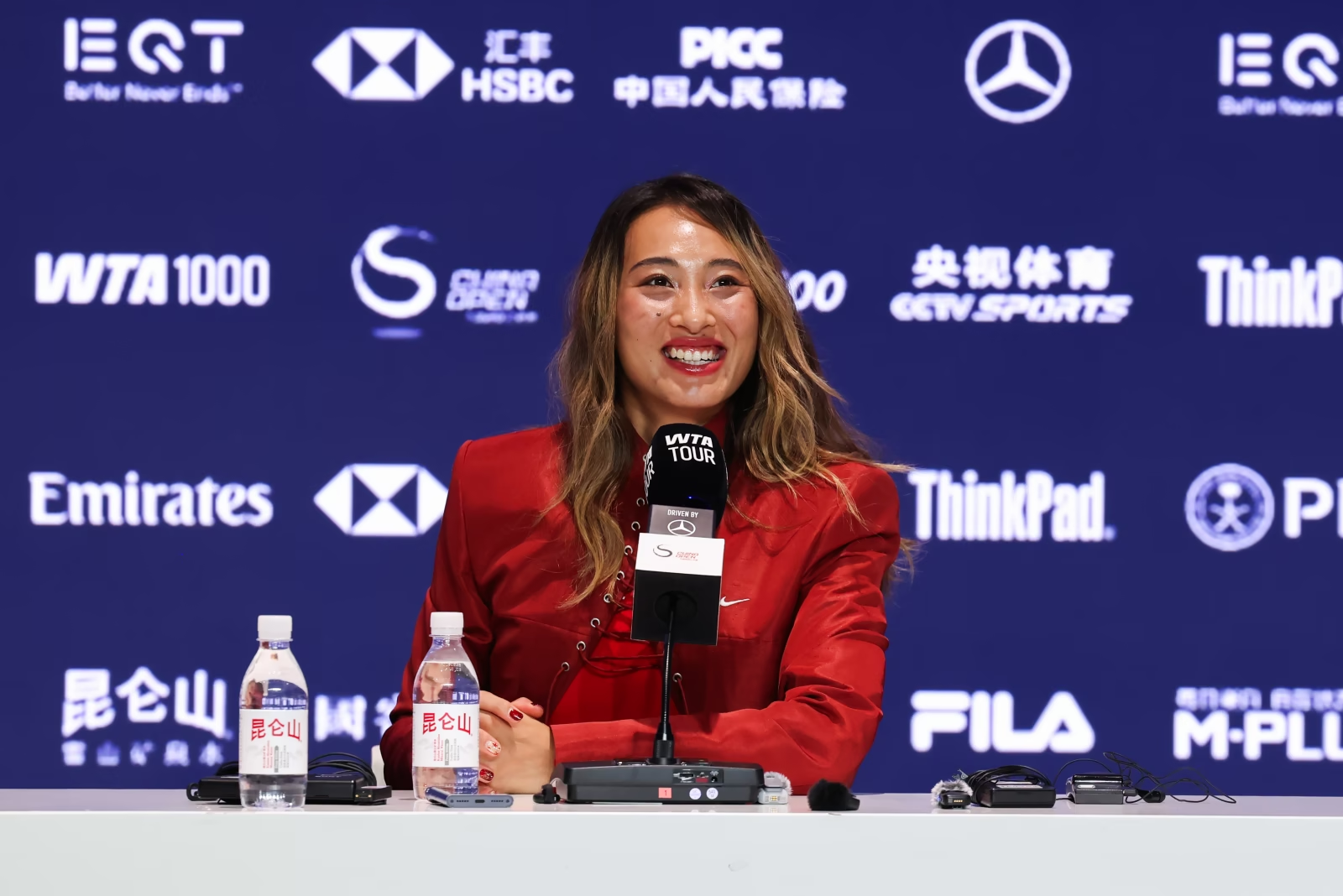
"Always be humble when you lose," Zheng said. "There are reasons. It might not have something to do with what you're doing. It might be the past two months, three months. That's what resulted in the result today.
"Be humble, keep your heads up. Don't let the crown drop."
By Jackson West

Weibo@ChinaOpen

WeChat Channel

Douyin@ChinaOpen
